

HOYER Guitars — History of a legendary brand
1949 HOYER GUITARS. History of a legendary brand
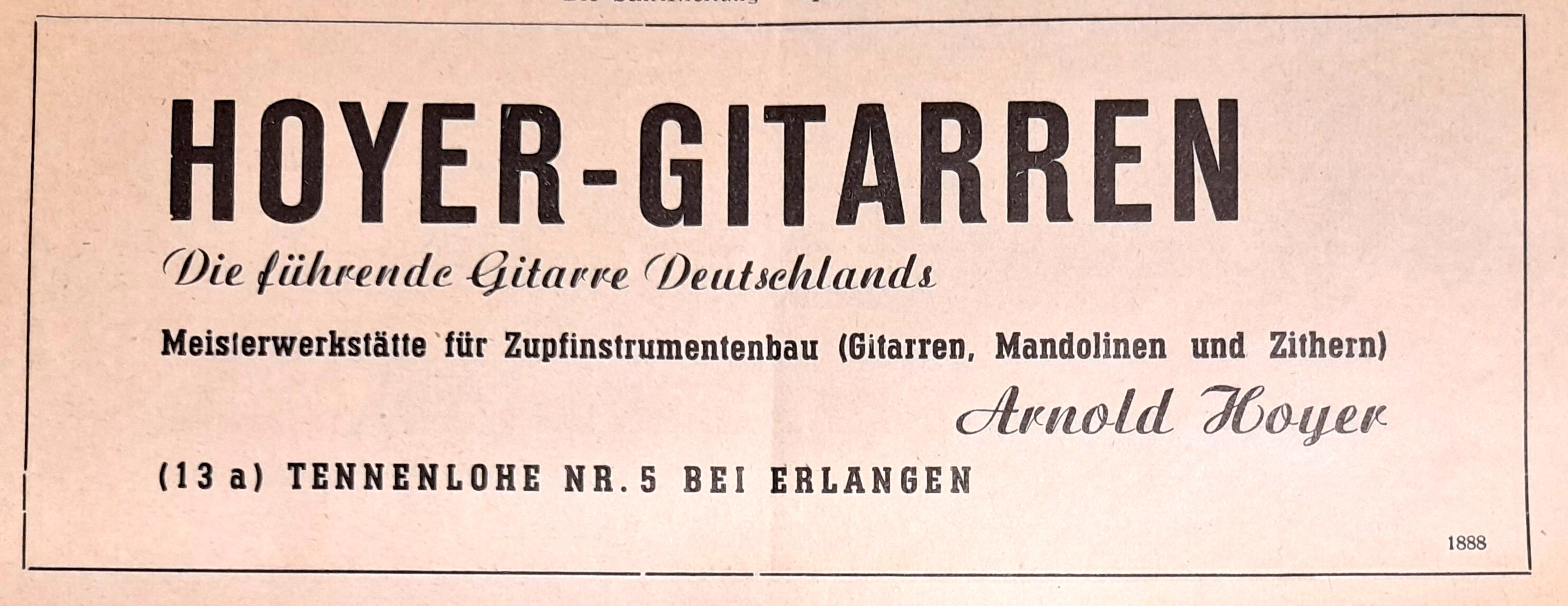
“Germany’s leading guitar brand.” With that slogan Arnold Hoyer confidently appeared in a 1949 advertisement in the instrument-making journal. And rightly so. Through quality and innovation his master workshop for plucked instruments had, in a short time, earned exactly that excellent reputation in the post-war years. Arnold Hoyer could look back on a long family tradition in musical instrument making. Abruptly interrupted by the Second World War and its consequences, from 1945 he rebuilt the firm — originally based in the music town of Schönbach in the Egerland — in Tennenlohe near Bubenreuth in Middle Franconia. Many Hoyer models from the 1940s to the 1980s are still regarded as iconic instruments today.
1874 Established 1874 — a note beforehand
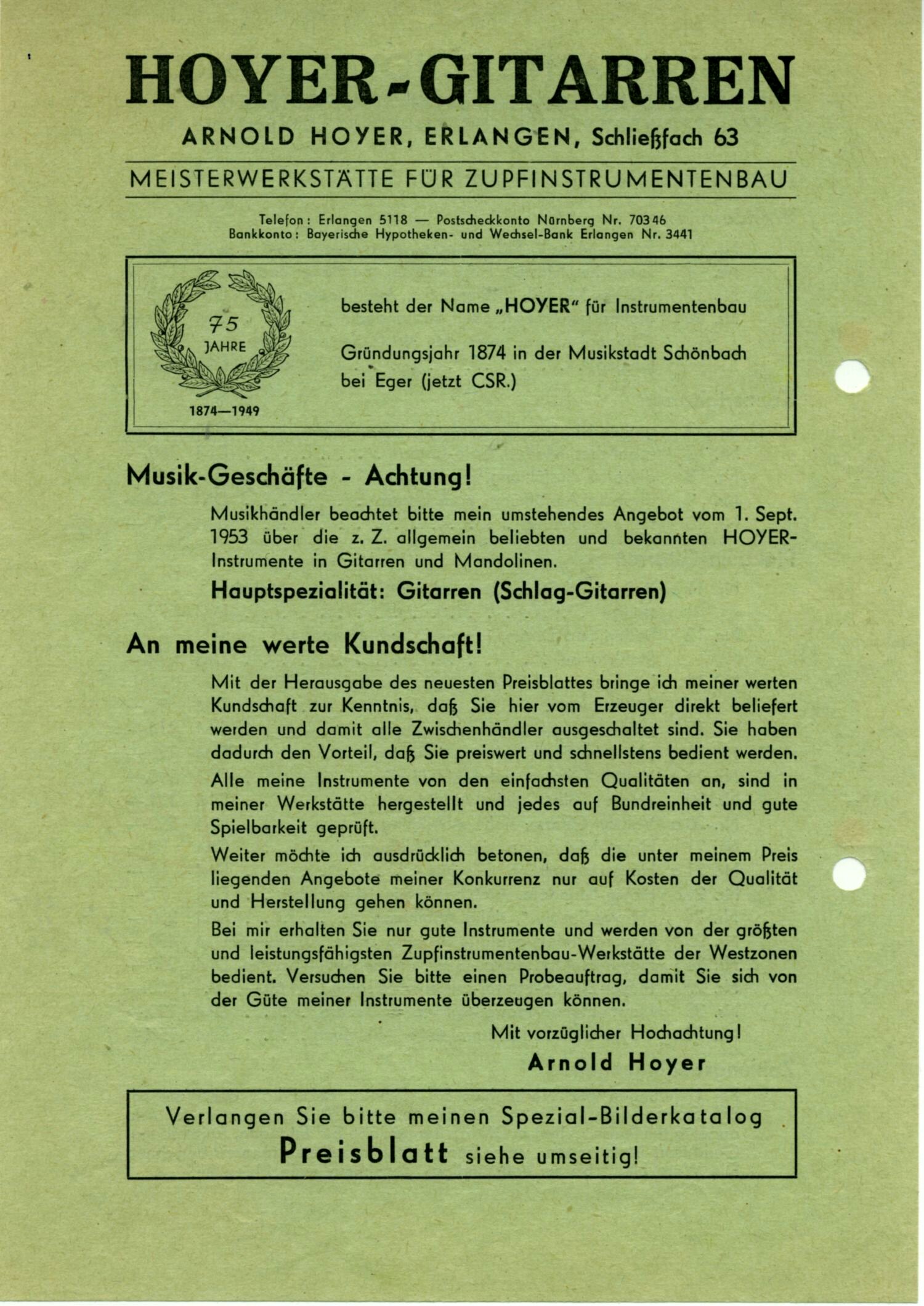
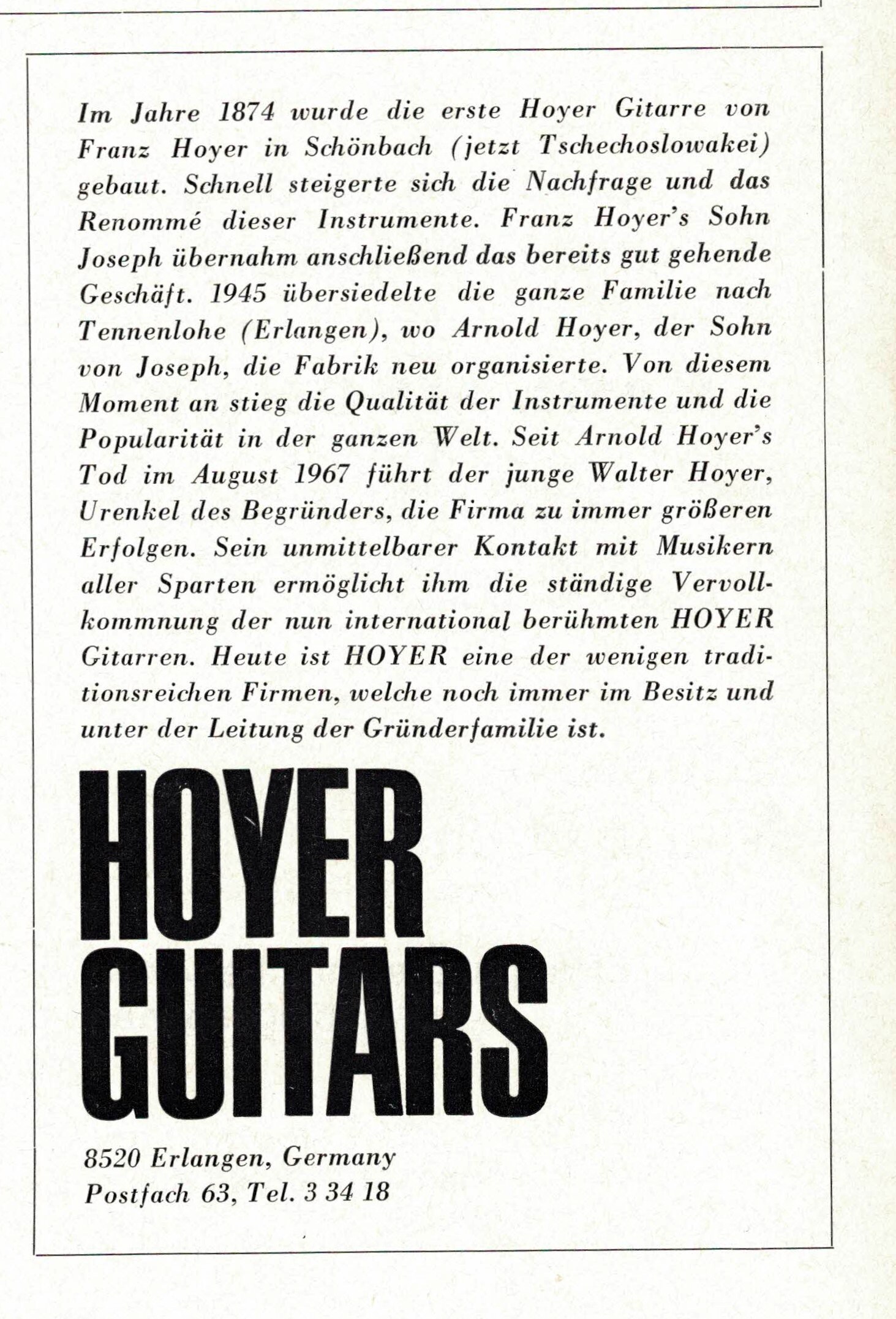
In 1949 Arnold Hoyer wanted to draw attention to his family’s long tradition in instrument making and first put forward the firm’s founding year of 1874, which has been held to ever since. He could also solemnly mark seventy-five years of the business. With that date he clearly referred to his grandfather Franz Hoyer. From today’s perspective it can no longer be fully reconstructed why he did not also invoke his great-grandfather, who had demonstrably founded a musical instrument business focused on bowed instruments and string spinning as early as 1838, while his father Josef Hoyer’s independent plucked-instrument workshop began in 1894. Since the guitar stood at the centre of Arnold Hoyer’s work, it seems likely that 1874 marks Franz Hoyer’s introduction of guitars into the firm’s range. For Arnold Hoyer, with his newly founded Bavarian firm, that was the decisive moment. Thus 1874 became the key year for Hoyer Guitars — a conclusion also suggested by the firm’s self-presentation in the Schönbach Heimatbuch of 1969.
1631 Roots in the Musikwinkel
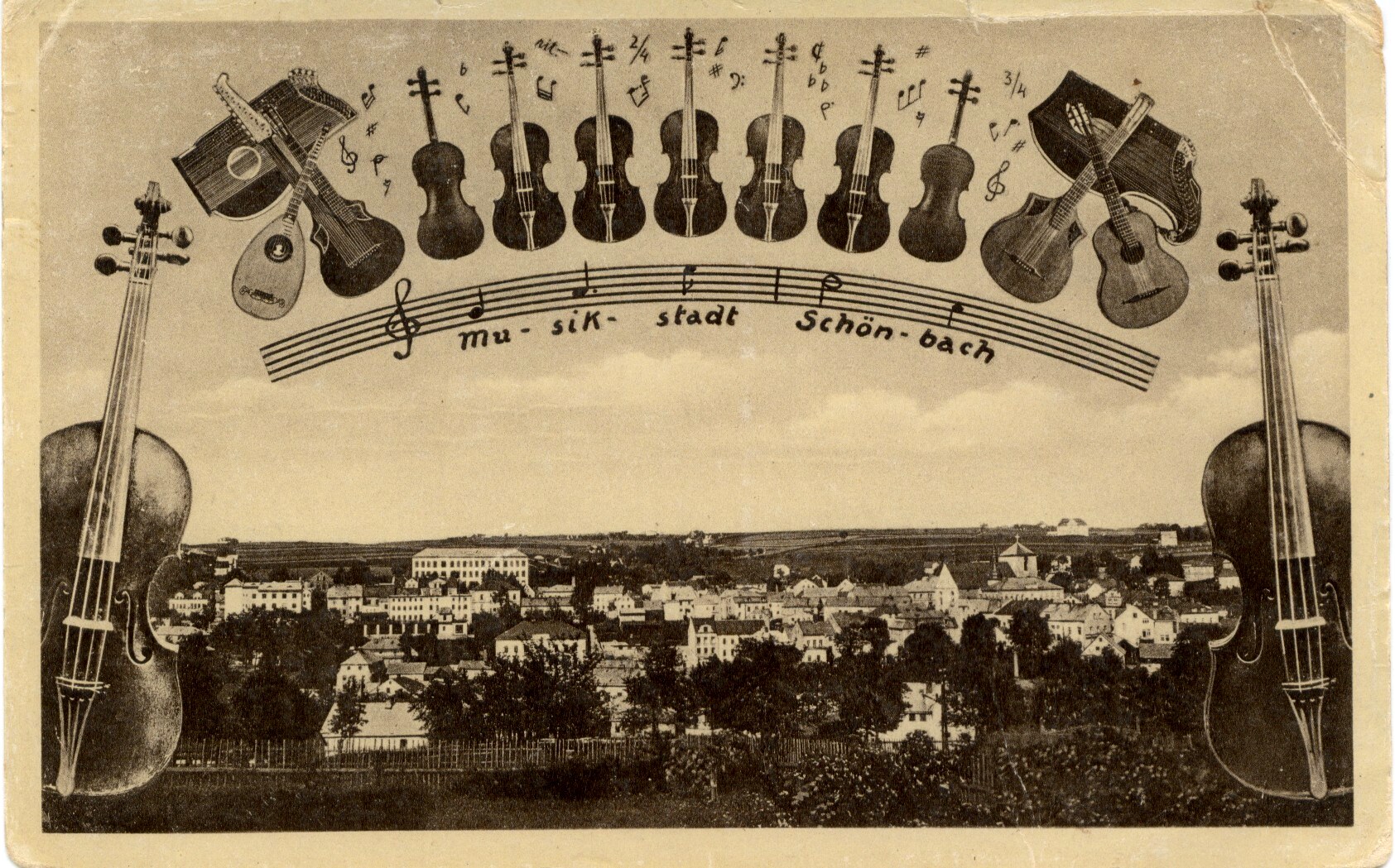
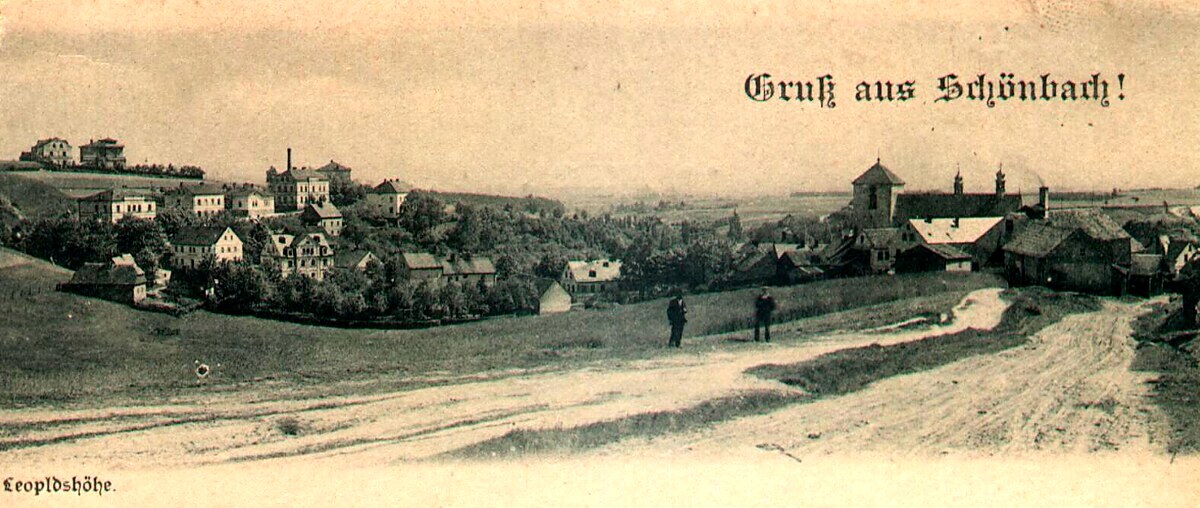
In musical instrument making the family name Hoyer carries great resonance. All instrument makers of that name share roots in the Saxon-Bohemian instrument-making region known as the “Musikwinkel”, around Markneukirchen and Klingenthal in the Vogtland, Graslitz (today Kraslice) and Schönbach in the Egerland (today Luby u Chebu).
As early as the seventeenth century a major cross-border economic cluster in instrument making arose there. In Graslitz the region’s first violin maker is recorded in 1631. The first genuine violin makers’ guild anywhere was founded there in 1669. Many Graslitz guild members appear a few years later as religious refugees in the Markneukirchen guild founded in 1677. In 1716 Klingenthal likewise formed a violin makers’ guild. As a kind of re-import, violin making was transplanted from Saxony to Schönbach in the 1720s; over the nineteenth century Schönbach became the most important centre for string instruments and their parts and accessories. Members of various Hoyer families worked in almost every town. The name Hoyer has thus for centuries been closely bound to German instrument making.
Over the nineteenth century Schönbach rose to become the stronghold of string-instrument production in the Musikwinkel. Many trained violin makers specialised after their apprenticeship in parts, intermediate products or particular instruments, so trades soon differentiated sharply. Independent crafts such as body maker, neck carver, peg turner, guitar maker, zither maker or mandolin maker became ordinary. On that basis a wide range of string instruments could be brought to market in relatively high numbers and remarkably good quality — chiefly through Markneukirchen trading houses. But Schönbach itself also saw music-instrument trading firms arise. Arnold Hoyer’s great-grandfather, the violin maker Johann Josef Hoyer, founded one such firm.
1838 J. F. Hoyer’s Sons — founded 1838
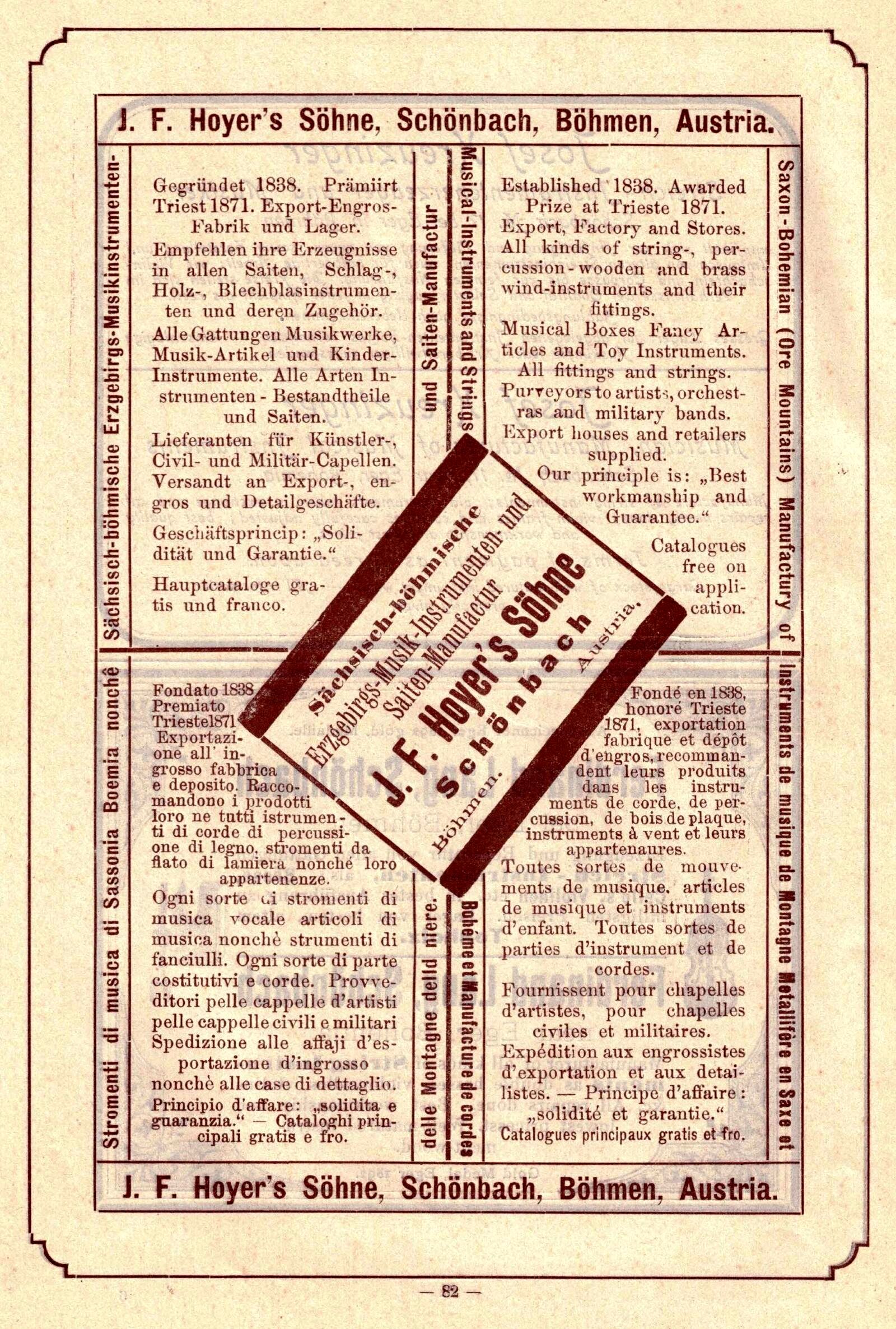
Around the turn of the century his firm traded as “J. F. Hoyer’s Sons”. It is the direct predecessor of “Hoyer Guitars”. The founders were Arnold Hoyer’s great-grandfather Johann Josef Hoyer (1815–1876) and his brother. Johann Josef was a trained violin maker. He soon added string spinning to violin production and finally opened a broad trading business in musical instruments. He was the first of his direct family line to take up instrument making; his ancestors had been furriers, coopers and millers.
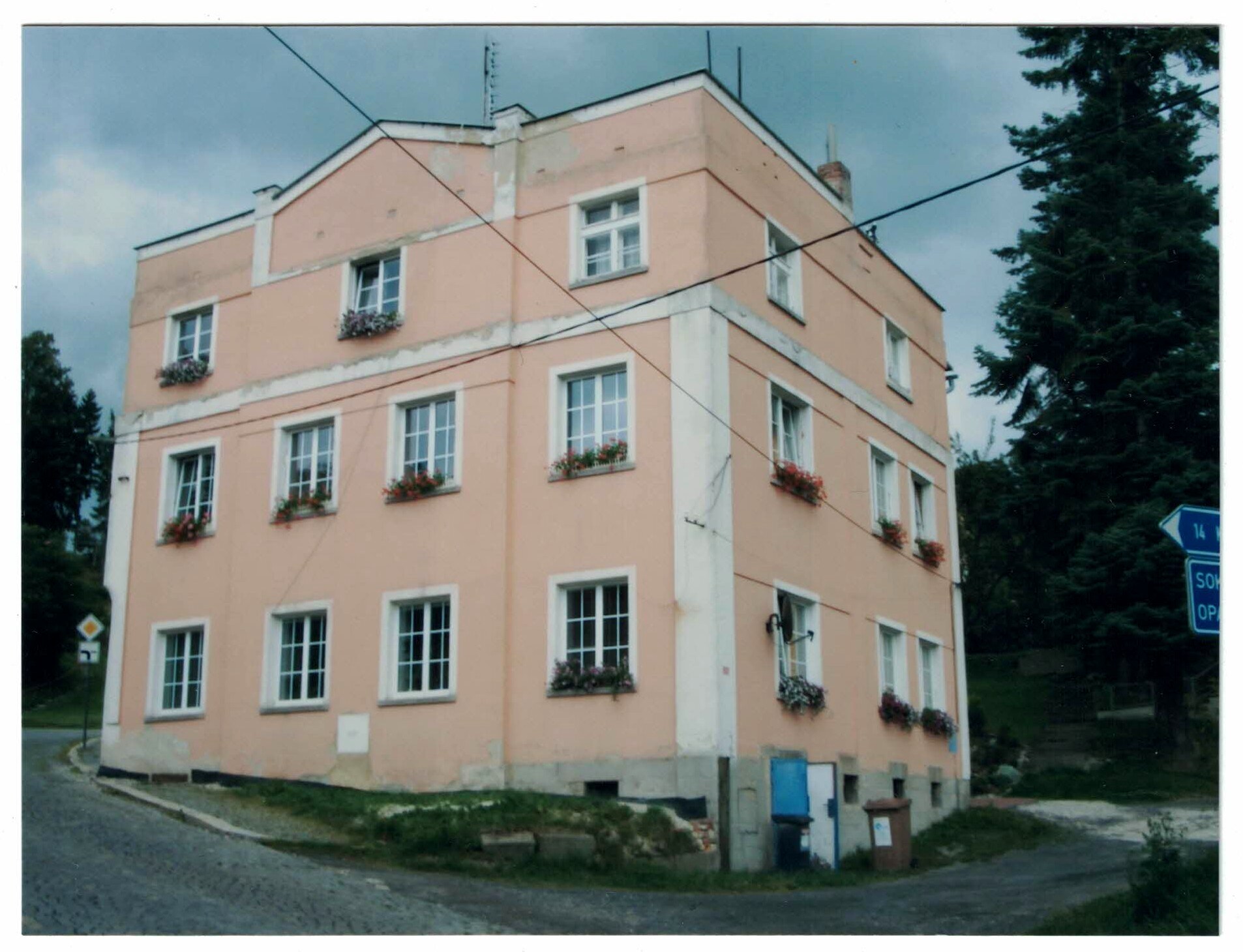
After the two brothers, Franz Hoyer (1842–1878), Johann Josef’s son, continued the firm. Franz was a string spinner and instrument dealer. In Trieste in 1871 instruments from his house were awarded at the “Esposizione Agricolo-Industriale e di Belle Arti”. In the 1870s he was able to build an imposing residential and commercial house in Schönbach on Falkenauer Straße (No. 316), which remained the firm’s seat until the expulsion from Schönbach after the Second World War. Franz died in 1878 aged only 36. His wife Elisabeth Hoyer (1842–1920), née Mettal, continued the firm until daughter Rosalia Anna (b. 1867) and son Josef (b. 1870) entered and later took it over. Rosalia married Graslitz merchant Josef Wohlrab in 1890. In the mid-1890s the firm was divided between the siblings. Rosalia and Josef Wohlrab gradually moved the trading business to Graslitz, where it continued until 1945 (latterly as “J. F. Hoyer’s Grandsons”), while Josef Hoyer remained in the parental property in Schönbach and concentrated on producing plucked instruments.
1894 Josef Hoyer’s plucked-instrument workshop since 1894
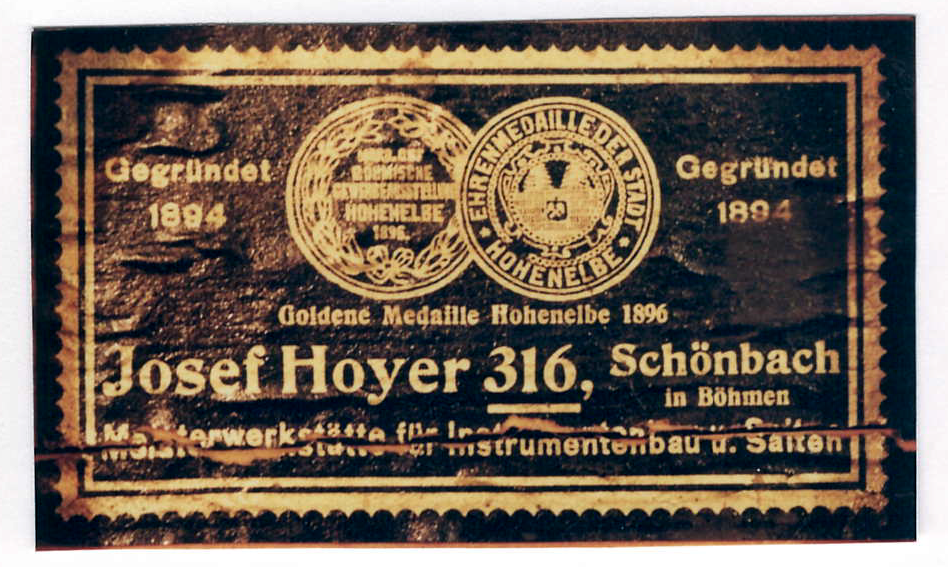
Josef Hoyer opened an entirely new chapter for the firm when in 1894 he established his own plucked-instrument workshop. His speciality was zithers and guitars. He had trained with his uncle. His maternal uncle Johann Mettal (b. 1846) had founded one of Schönbach’s best-known plucked-instrument dynasties in the 1860s. Mettal took the young half-orphan under his wing and gave him early insight into the craft. The guitars Franz Hoyer added to the range in 1874 almost certainly came originally from his brother-in-law’s Mettal workshop. Josef later perfected his skills with plucked-instrument and zither maker Josef Siebenhüner, then trained further with Schönbach maker Carl Loos, before qualifying and working for some years as a journeyman with Franz and Rudolf Siebenhüner. At 24 he finally set up on his own in Schönbach. He always gave that year as the founding year of his plucked-instrument workshop (not of the trading business or the string spinning): on price lists, in advertisements, on letterheads, and on the labels he glued into his instruments.
1900 First-class instruments and a guitar-making dynasty
Josef Hoyer was the first plucked-instrument maker in the family — restless, commercially astute and innovative. As early as 1896 he had his own stand at the North Bohemian trade exhibition in Hohenelbe (today Vrchlabí). His workshop was awarded a gold medal there. A year later in Bodenbach (today Podmokly) he received a silver medal.
Very few Schönbach makers took the arduous path of attending exhibitions. Josef sought direct contact with his customers. He was already printing his own catalogues in the 1890s. In 1897 a remarkable full-page advertisement in a Schönbach promotional booklet appeared in four languages: German, English, French and Italian.
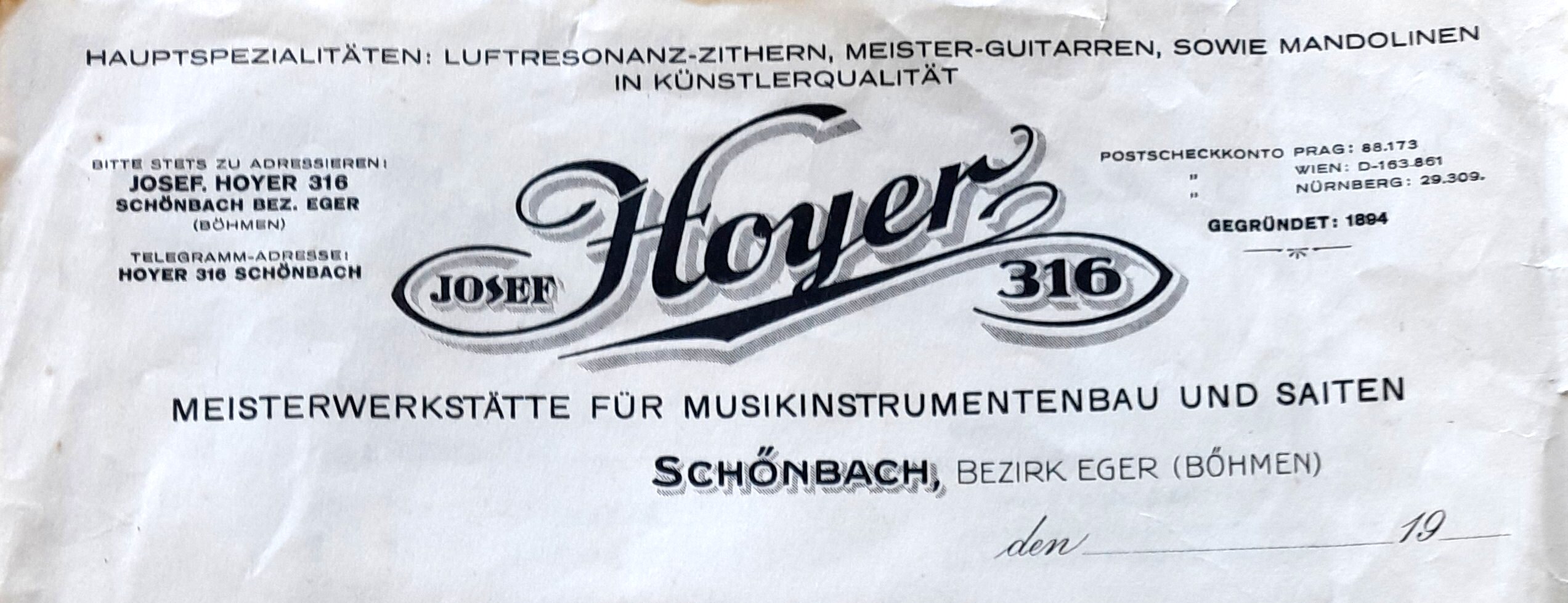
In 1900 Josef opened a new chapter when on 20 November he married Marie Mayer. Six children reached adulthood. Three sons became plucked-instrument makers: Arnold (b. 1905), Rudolf (b. 1906) and Roman (b. 1912). As fashions turned against the zither, Josef concentrated on mandolins and increasingly on guitars. His letterhead now used “master workshop”, listing as specialities air-resonance zithers, master guitars and mandolins of artist quality.
Josef left nothing to chance in choosing tonewoods, buying them himself in the Carpathians and the Alps before the First World War. In 1913 he patented a development in Germany. At the German-Bohemian regional show in Komotau (today Chomutov) in 1913 he was again awarded a gold medal.
1921 World war, recovery and the 1921 jubilee
The First World War marked a deep break. Production of musical instruments in Schönbach was drastically cut; many makers had to exchange tools for weapons. When the war ended after more than four years, nothing was as before. The German-Bohemian territories, including Schönbach, were incorporated into the newly founded Czechoslovak state.
Belonging to the new republic also brought advantages: as a victor state, doors to the West stood wide open. Josef immediately set about rebuilding. By 1921 his instruments were again present at the Vienna theatre and concert fair.
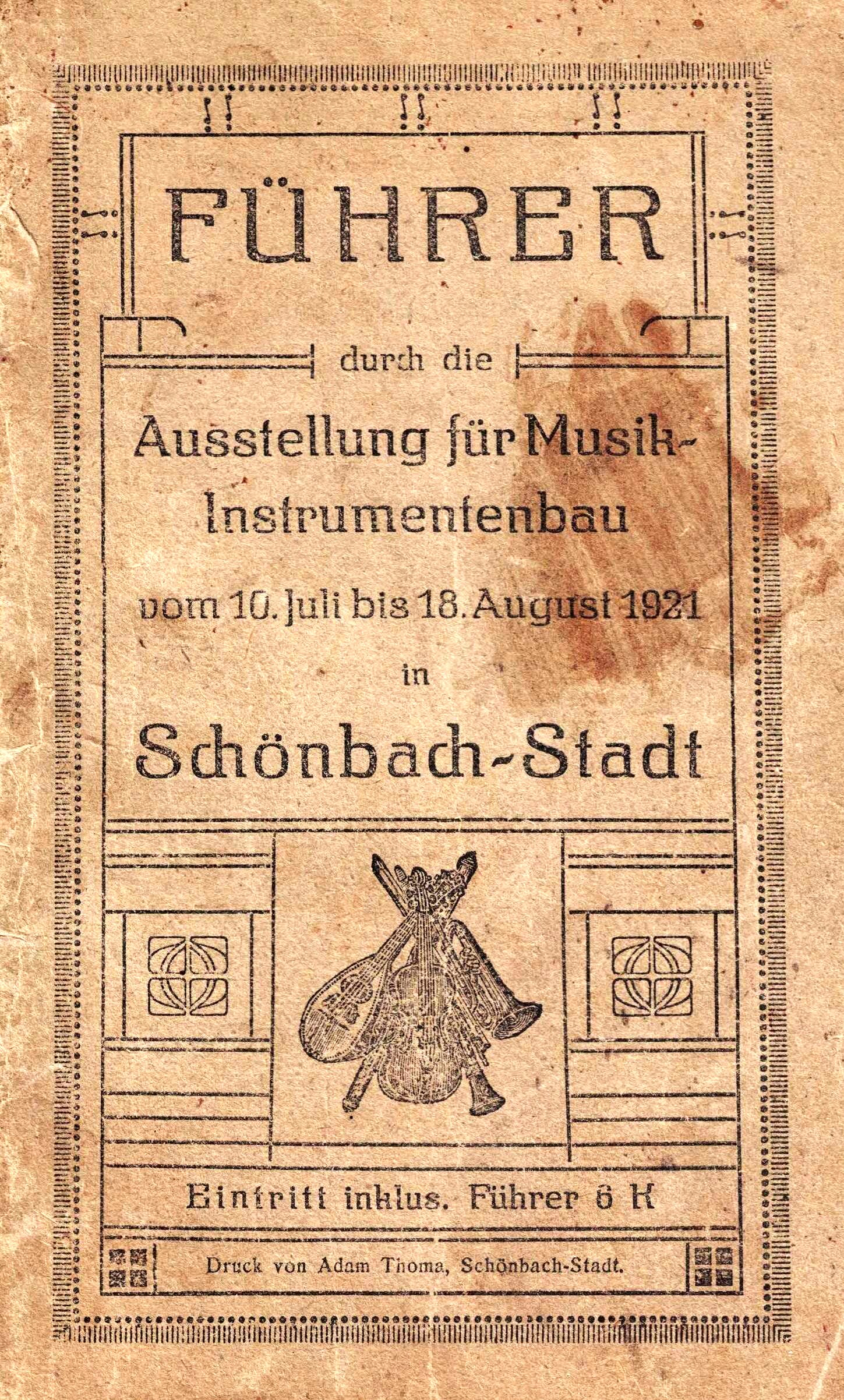
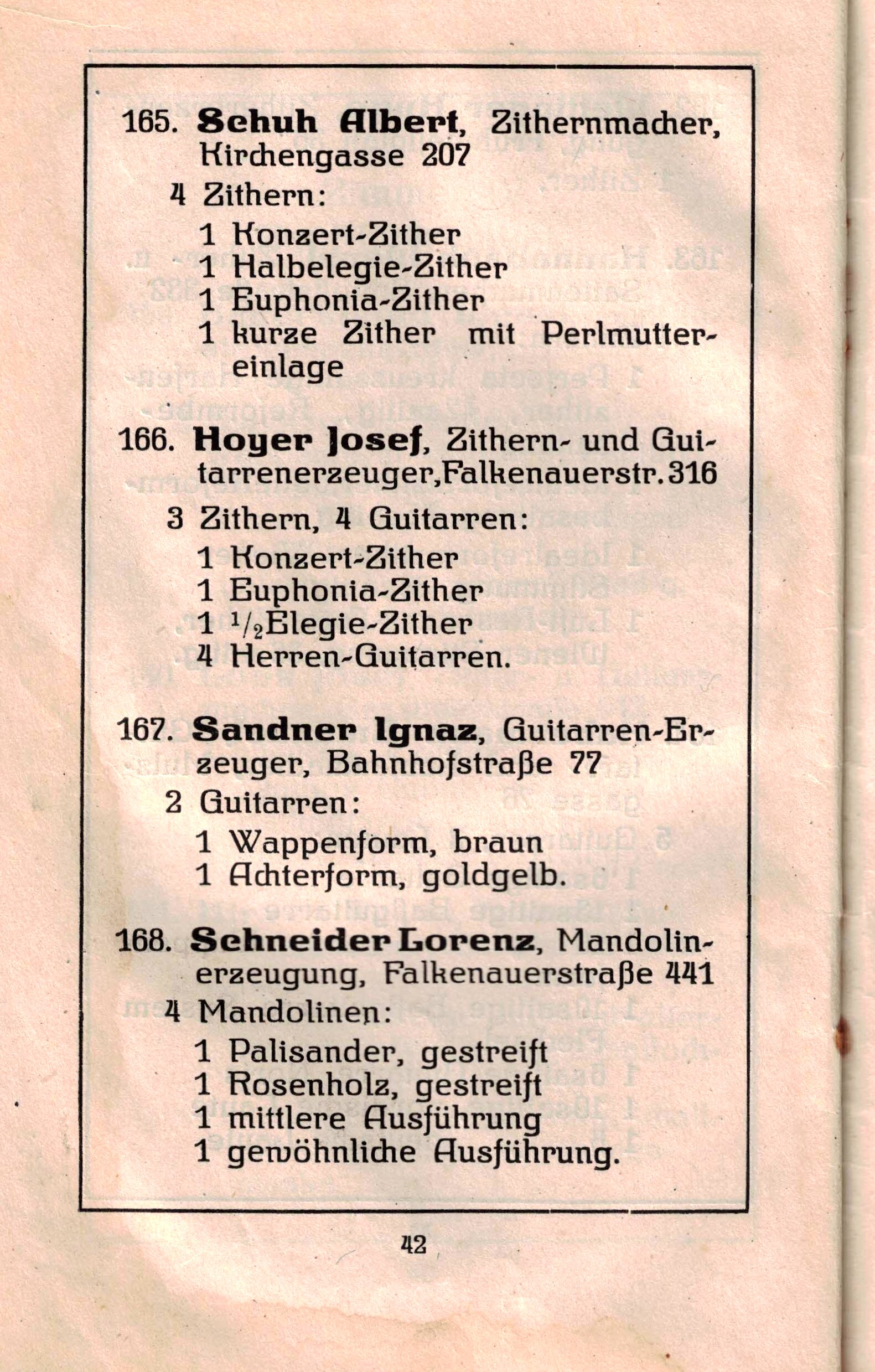
Somewhat delayed, Schönbach celebrated the 600th anniversary of its town charter in grand style in 1921. From 10 July to 18 August, 217 Schönbach exhibitors showed their work. Josef Hoyer, listed in the catalogue as a zither and guitar maker, showed three zithers and four gentlemen’s guitars.
1927 Monument, expansion and the workshop
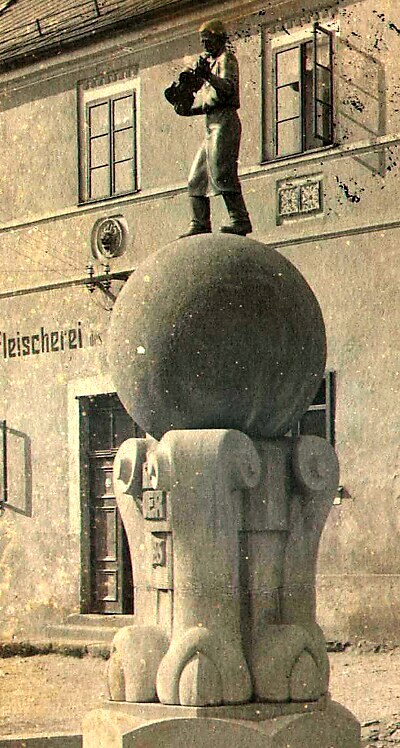
The first half of the 1920s was a time of upward drive for Schönbach. In 1927, as an expression of regained confidence, the town raised its own violin makers’ monument in the centre.
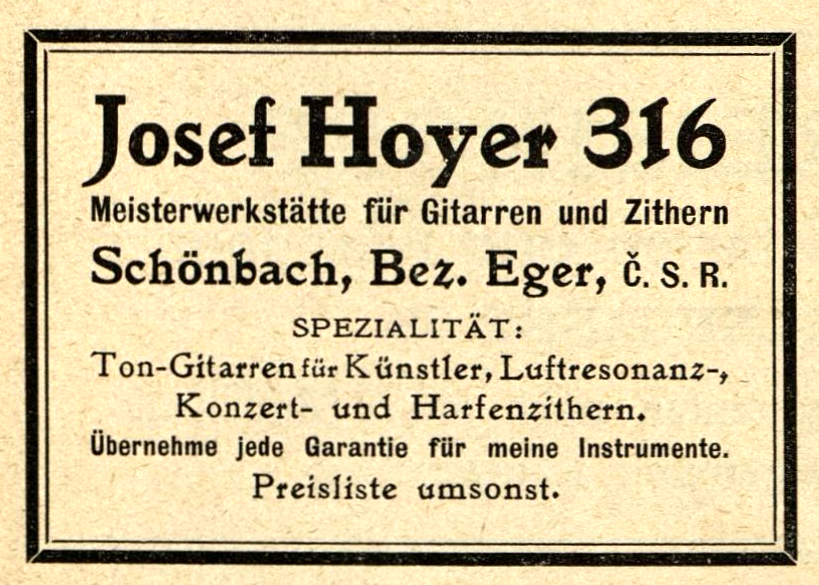
Josef revived and expanded his workshop. In 1926 he advertised in Vienna’s “Zeitschrift für die Gitarre” for his master workshop for guitars and zithers. He likely raised the family house at Falkenauer Straße 316 by a storey and also used neighbouring No. 385 for production.
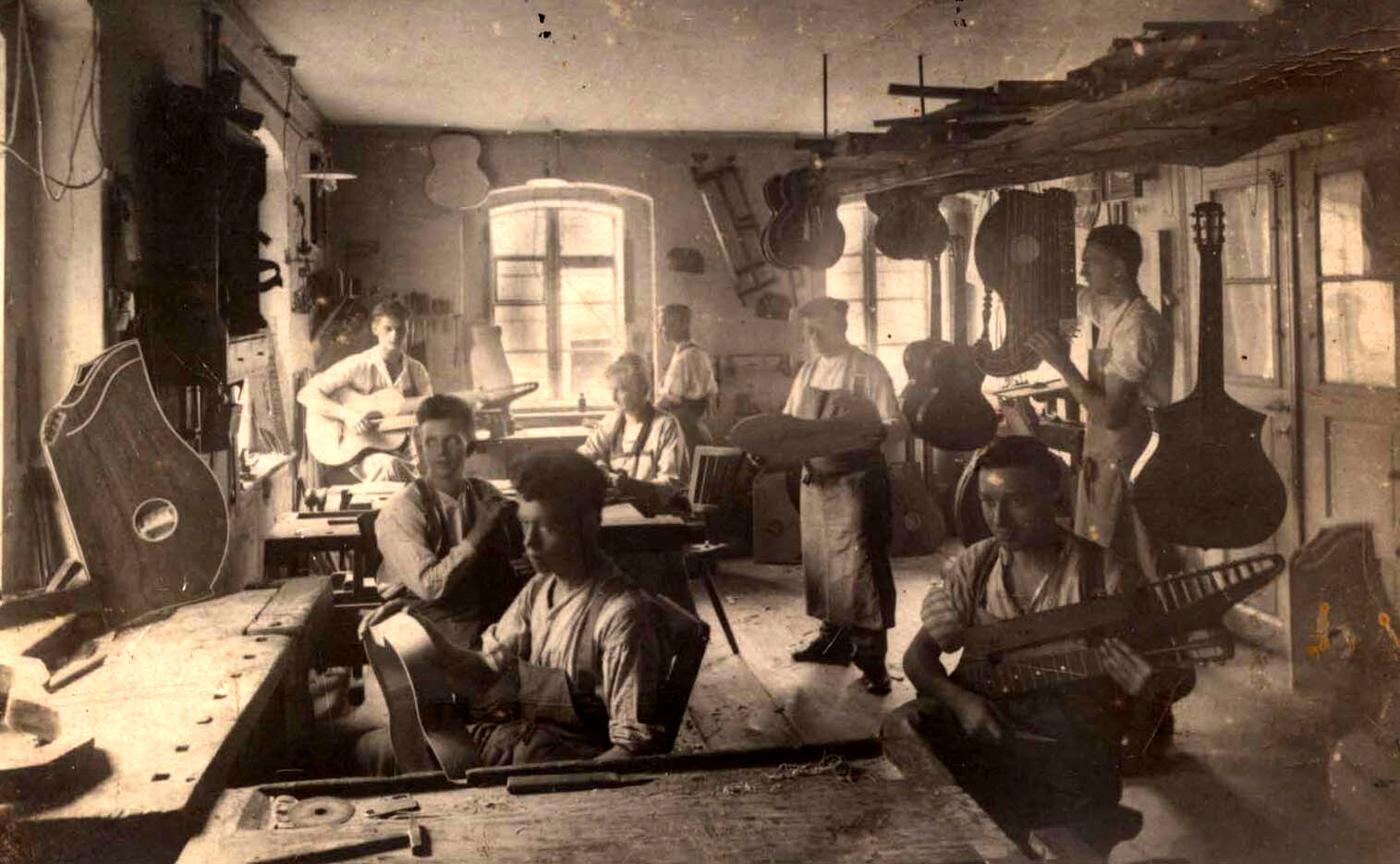
Sons Arnold (b. 1905), Rudolf (b. 1906) and Roman (b. 1912) entered the firm in turn. Arnold was formally apprenticed by 1919 at the latest. Josef’s reputation was such that many sought training with him. The first photograph of the Hoyer workshop, from the mid-1920s, shows eight people.
1936 Crisis, archtops and the Cologne adventure
The Great Depression of 1929 devastated Schönbach instrument making. Production in 1932 fell by more than 60 percent against the 1920s. Josef Hoyer and his sons felt the crisis too.
Hope lay in new fashions. Many Schönbach makers, including Josef Hoyer, built ukuleles at scale. Somewhat later the American-influenced archtop style took hold. The Josef Hoyer firm developed several models in the early 1930s. Schönbach goods were often made for Markneukirchen houses — for example C. G. Glier & Sons under the “Cyrano” name.
Arnold decided to move to Cologne. Rudolf stayed in Schönbach and from about 1935 officially managed the family firm. By 1936 at latest Arnold and his wife settled on the Rhine. Son Arnold Walter Hoyer was born in 1938 and baptised in Cologne Cathedral. At Am Eigelstein 88 Arnold ran a small workshop with a shop. The link between Schönbach and Cologne was close: woods, parts and knowledge flowed both ways.
1942 War again
The good times did not last. Hitler’s war cut the link to export markets. Most Schönbach instrument shops closed. By the end of 1940 the Hoyer works were temporarily shut down. Rudolf and Roman were drafted into the Wehrmacht.
Operation Millennium on 30/31 May 1942 heavily hit Cologne’s centre. Those experiences led Arnold to return to Schönbach during 1942. In the 1943 directory he is again at Falkenauer Straße 316 as a “guitar maker” — but he was not allowed to work in his trade. After an earlier accident in which he lost his right thumb, he worked in a case factory converted to ammunition crates.
When the US Army entered on 6 May 1945, the war ended in Schönbach. Music was a pastime for many G.I.s. Archtop guitars were of great interest — and Arnold Hoyer and the Americans soon “got into business”.
1945 To Bavaria on US trucks
With help from G.I.s, Arnold Hoyer left Schönbach westward as early as June 1945. His entire workshop inventory — tonewood, finished instruments and furniture — was loaded onto two US Army trucks and taken to Tennenlohe near Erlangen in Bavaria, against the background of expropriation and impending expulsion.
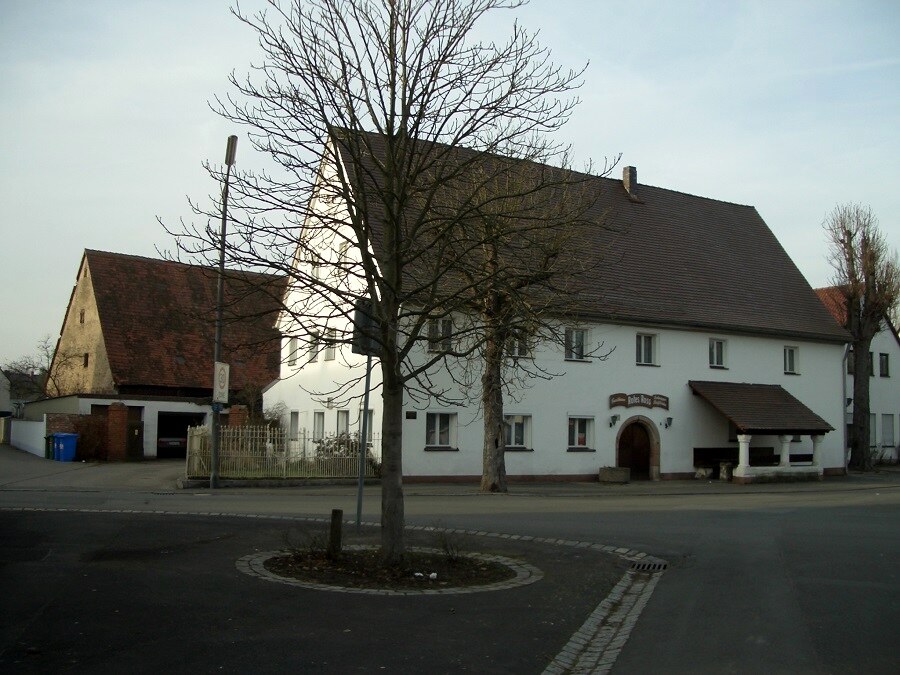
By July 1945 Arnold was in Tennenlohe. In the dance hall of the inn “Rotes Ross” he set up his workshop. Brought wood and tools allowed production to start in August 1945. At the end of October the Bavarian Ministry of Economic Affairs officially opened the way for settling Schönbach’s small musical-instrument industry in the Erlangen district.
1949 Bubenreuth rises — Hoyer stays in Tennenlohe
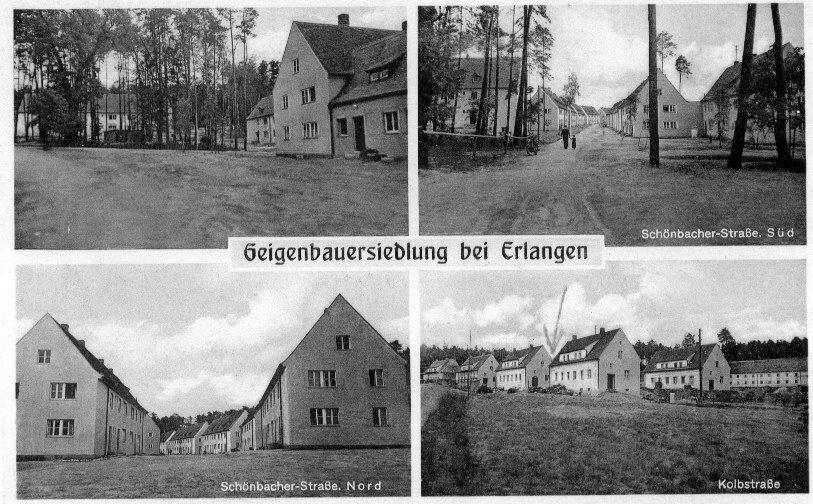
The whole “Schönbach system” of division of labour and specialisation had to be transplanted. Efforts for a closed settlement in Tennenlohe first failed; Munich ordered Garmisch-Partenkirchen and Mittenwald. Firms already established around Erlangen — not least Arnold Hoyer — refused to move again.
Only persistent rebuilding and Erlangen district administrator Hönekopp, newly elected in 1948, brought the groups together in the district. From October 1949 the “violin makers’ settlement” rose in Bubenreuth.
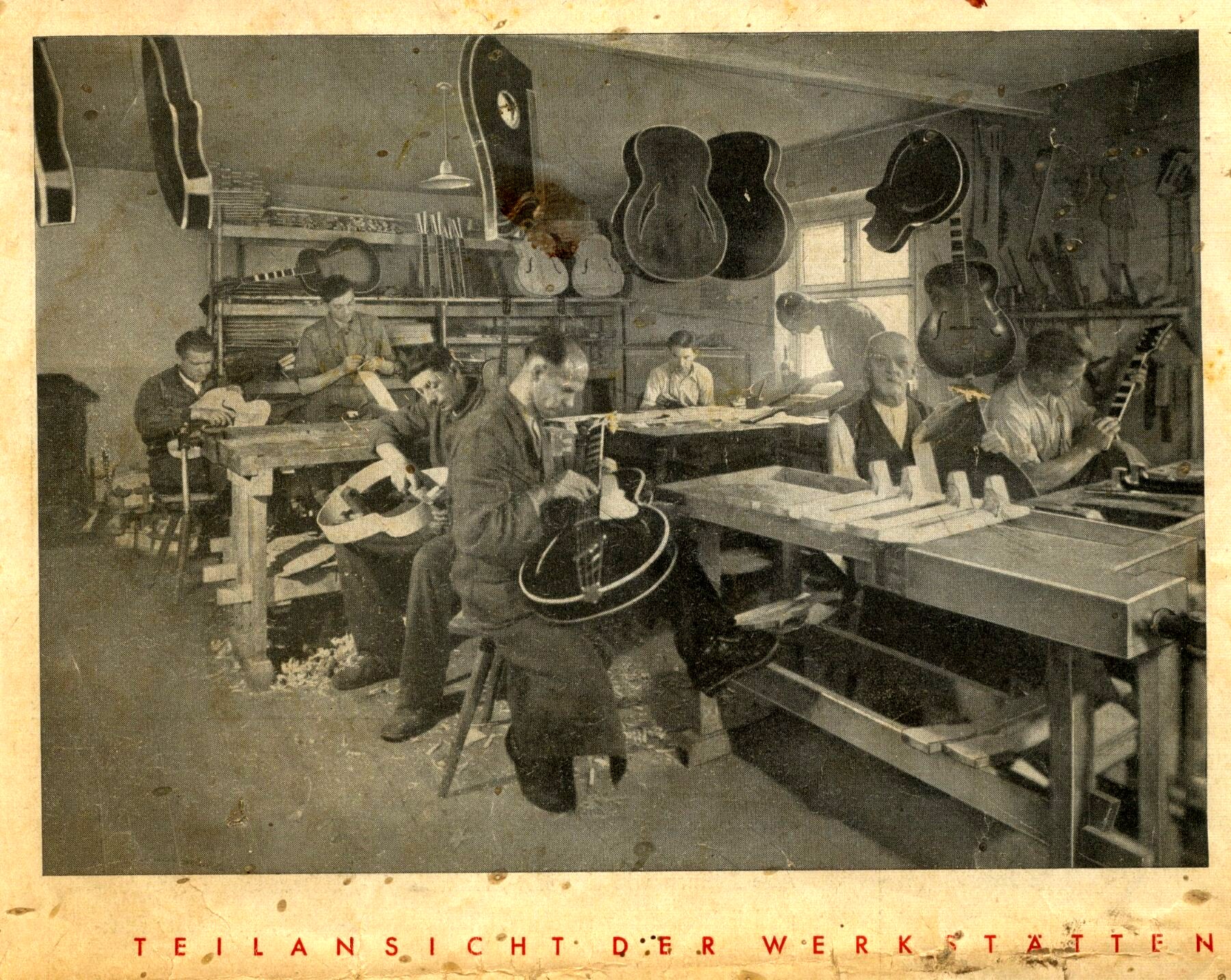
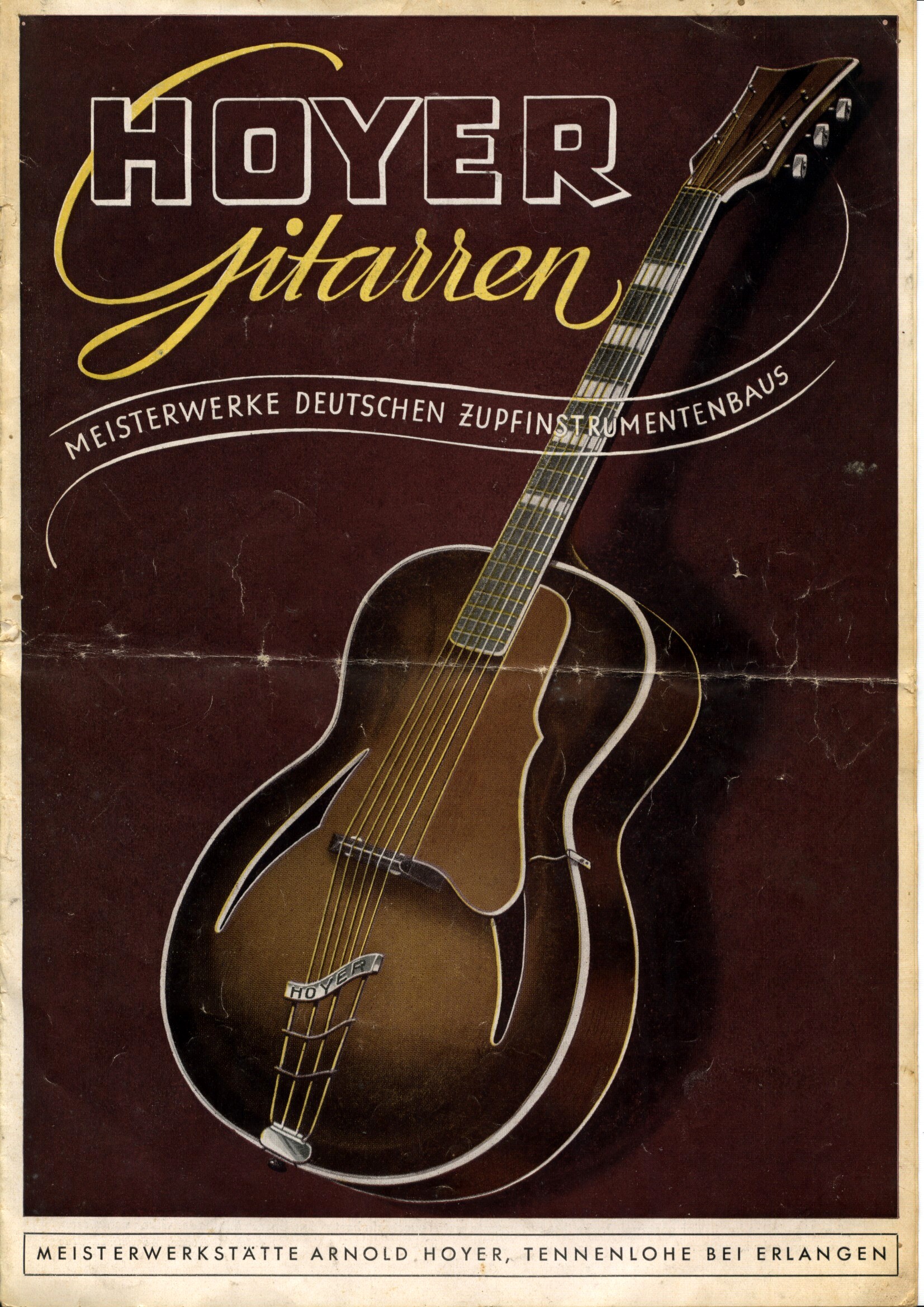
Arnold did not move to Bubenreuth after 1949; he stayed in Tennenlohe. By 1947 he had bought a larger plot and a year later built a house. Remarkably, shortly after currency reform he issued a catalogue regarded as the first in the trade in the post-war period. The cover showed what he understood: archtops.
1950 Archtop king in Germany
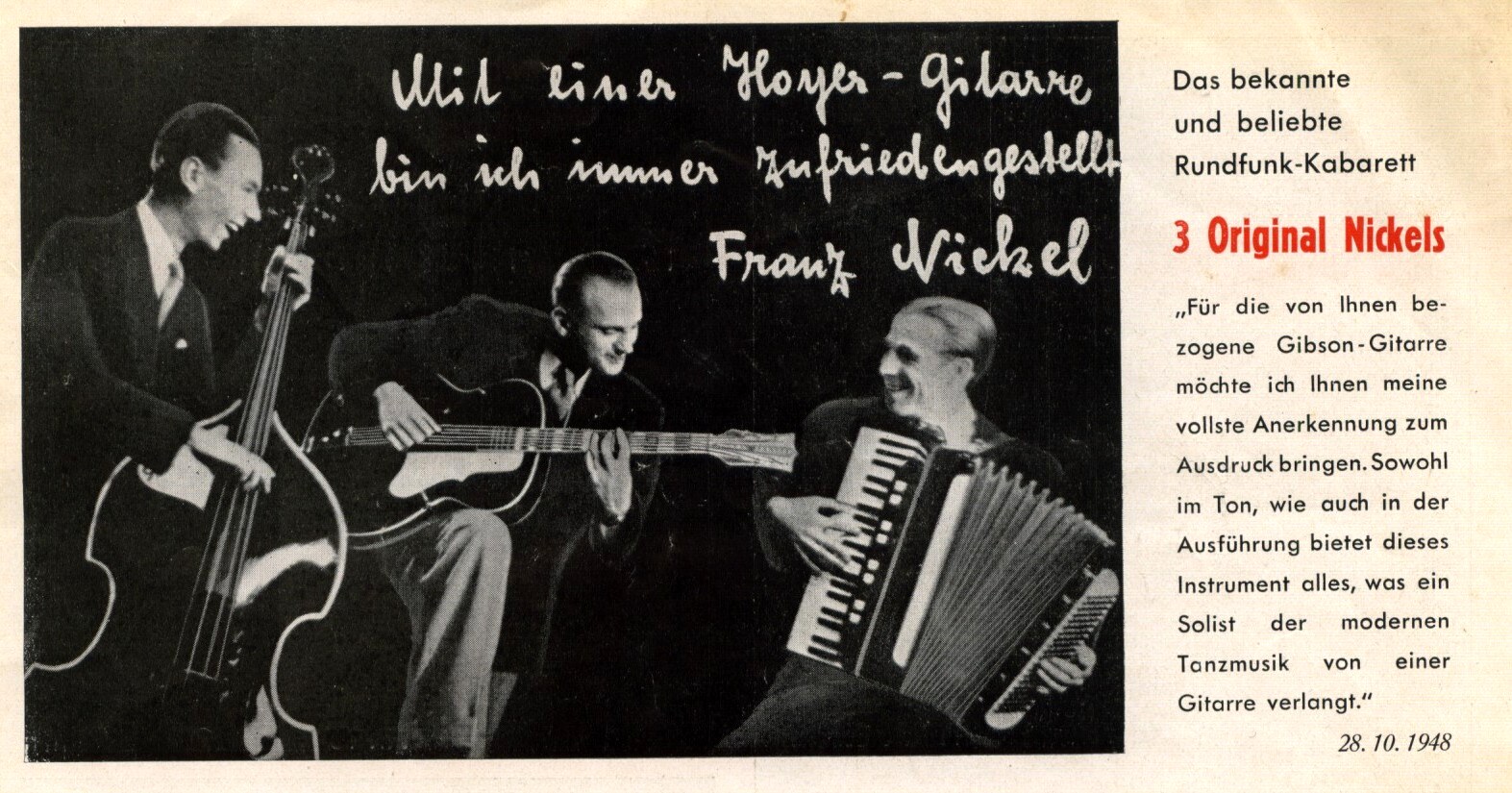
Arnold Hoyer built his reputation on first-class archtop guitars. He became a model for many other makers. His workshop became a top address for professionals and demanding amateurs. A reporter at the second German musical instrument fair in Mittenwald noted in 1950 that with imaginatively appointed rhythm guitars Arnold Hoyer of Tennenlohe near Erlangen made his mark. From then on he justifiably advertised with the slogan “Germany’s leading guitar brand”.
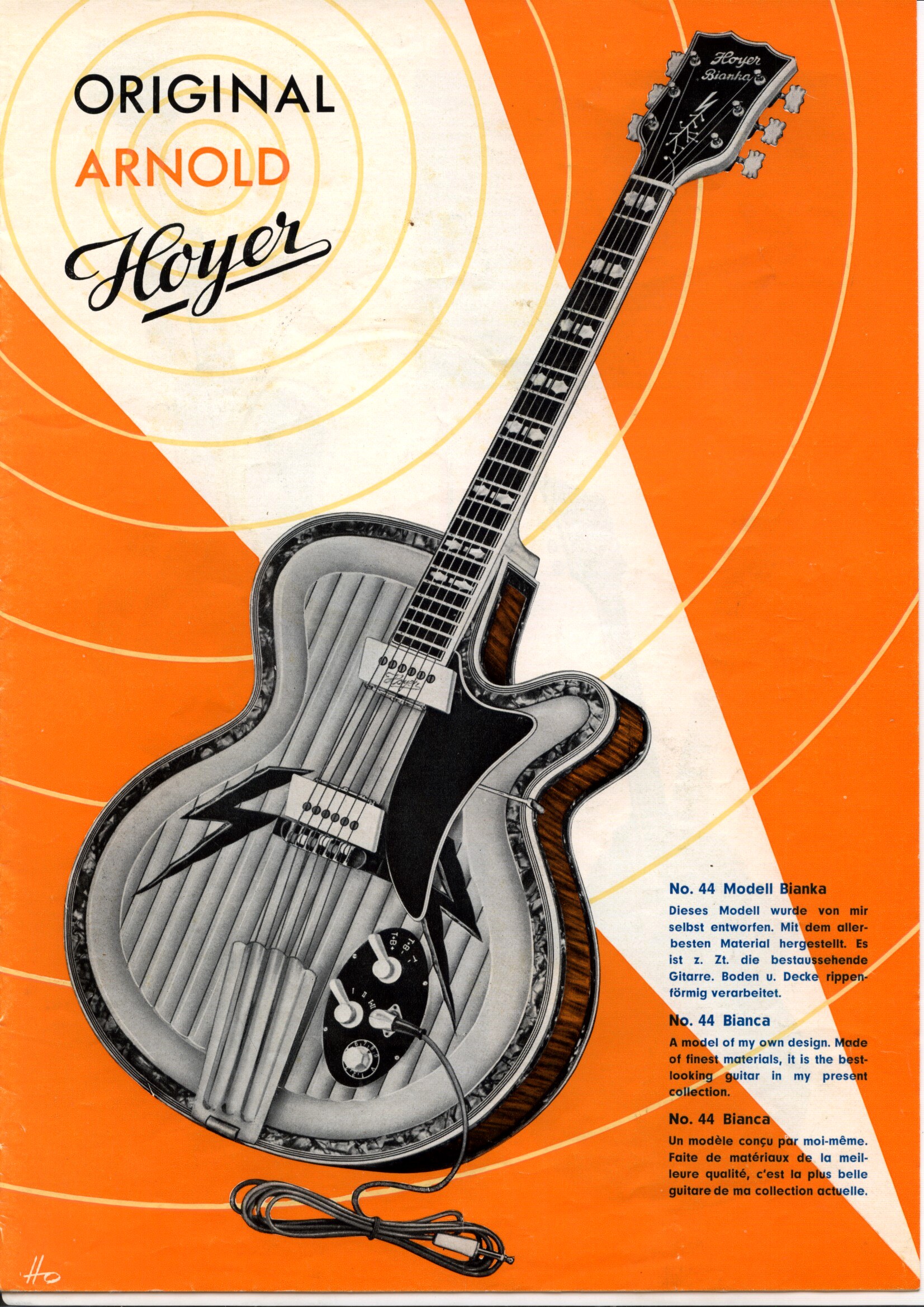
Iconic instruments such as the archtops “Herr im Frack”, “Solist”, “Meisterklasse”, “Spezial”, “Bianka” and “Fantastik” still testify to the ambition of his workshop. The re-founded guild elected him deputy master of the guild.
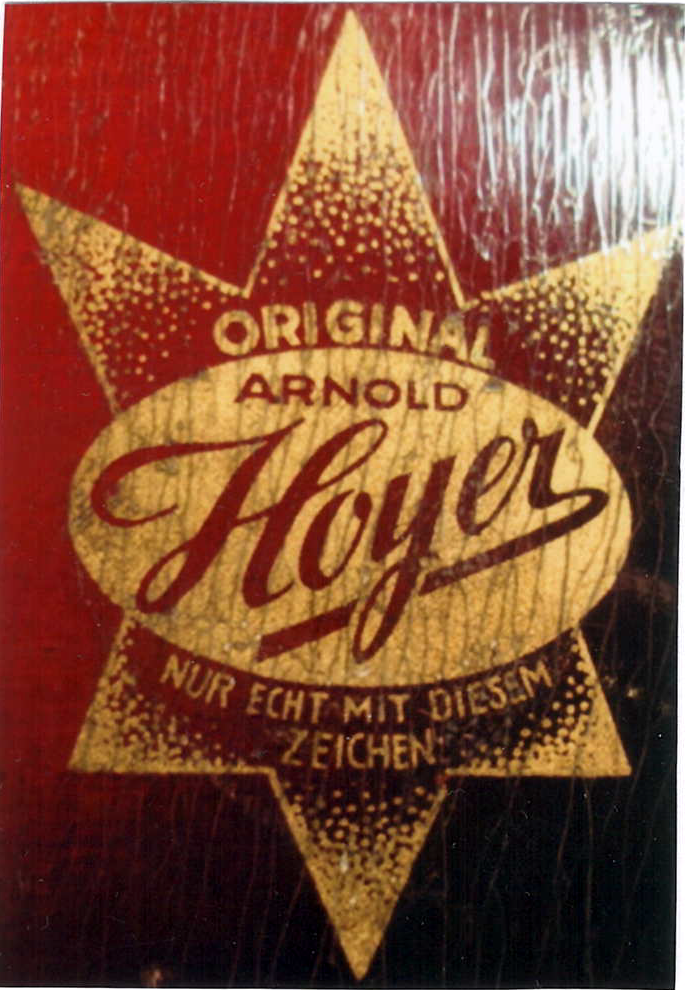
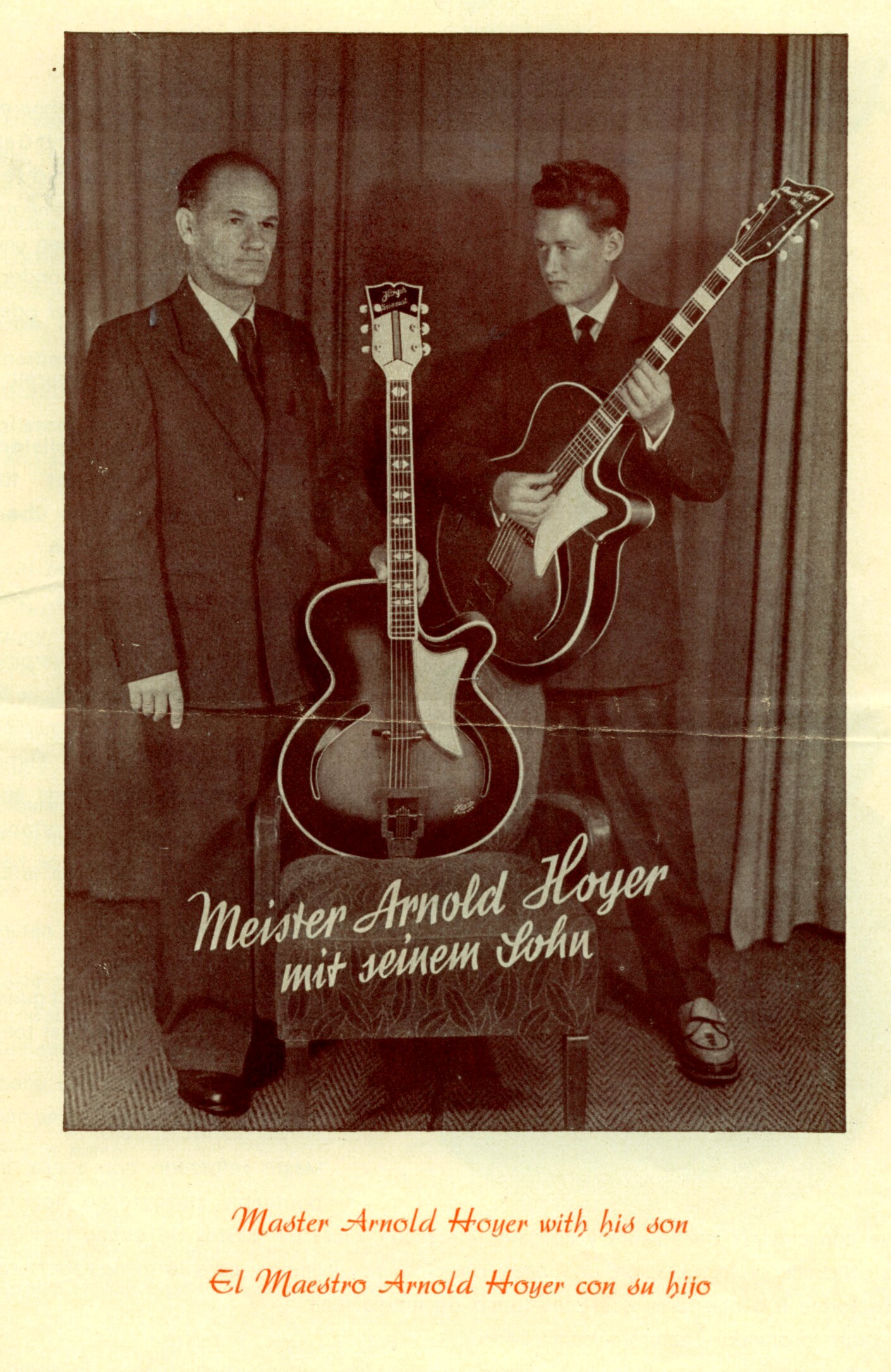
1967 Walter Hoyer and the new beginning
After Arnold Hoyer’s early death, his son Walter Hoyer (1938–2026) took over management in 1967. He modernised production toward high-quality western and electric guitars. In 1966 he had passed his master examination. Under his leadership came models of the “HG” series and the unusual “Foldaxe” with a folding neck.
In difficult economic times bankruptcy had to be filed in 1976 despite the brand’s cult standing. Production continued for some years at the Erlangen Thalermühle until it finally ceased in 1987.
After the end in the 1980s, trademark rights first lay with a German music wholesaler and later a private owner in Germany. Since 2009 the historic brand has belonged to Martin Ritter, Singapore, who is working on a careful, long-term revival.
For decades Hoyer instruments found their way to professional musicians, collectors and well-known stage and studio productions. Historical Hoyer instruments still enjoy a special reputation among connoisseurs, collectors and players. That is what we build on.
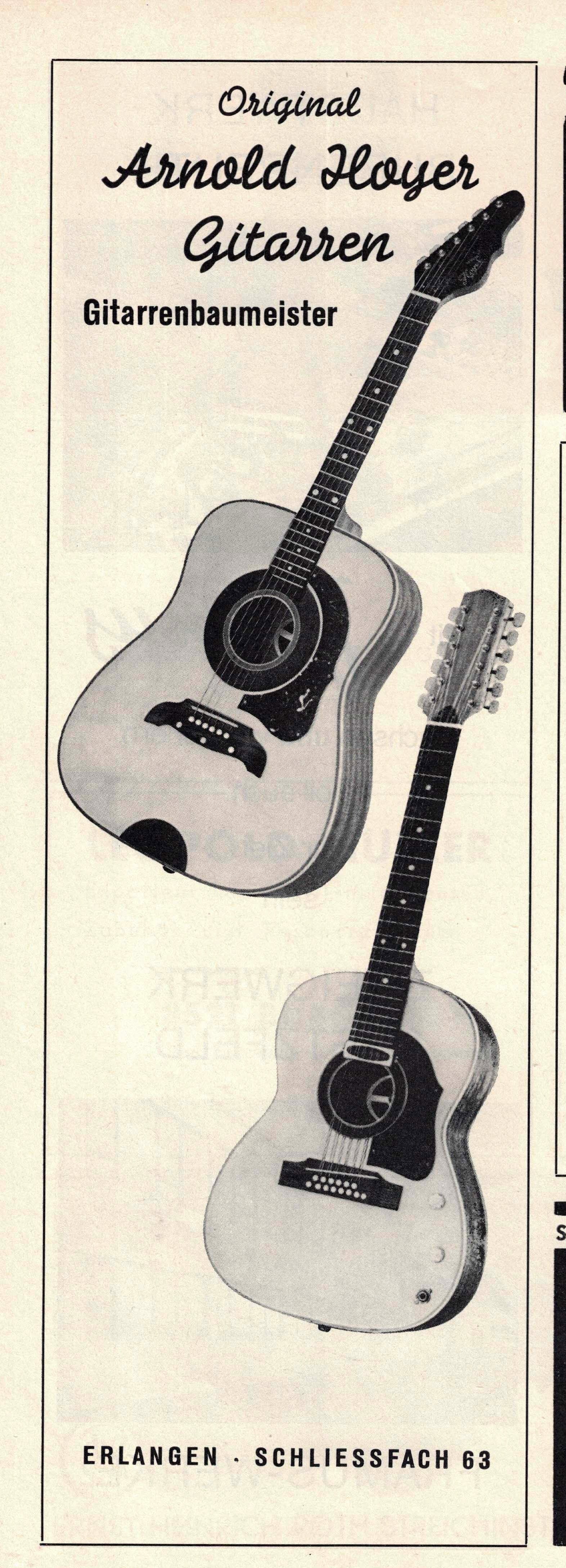
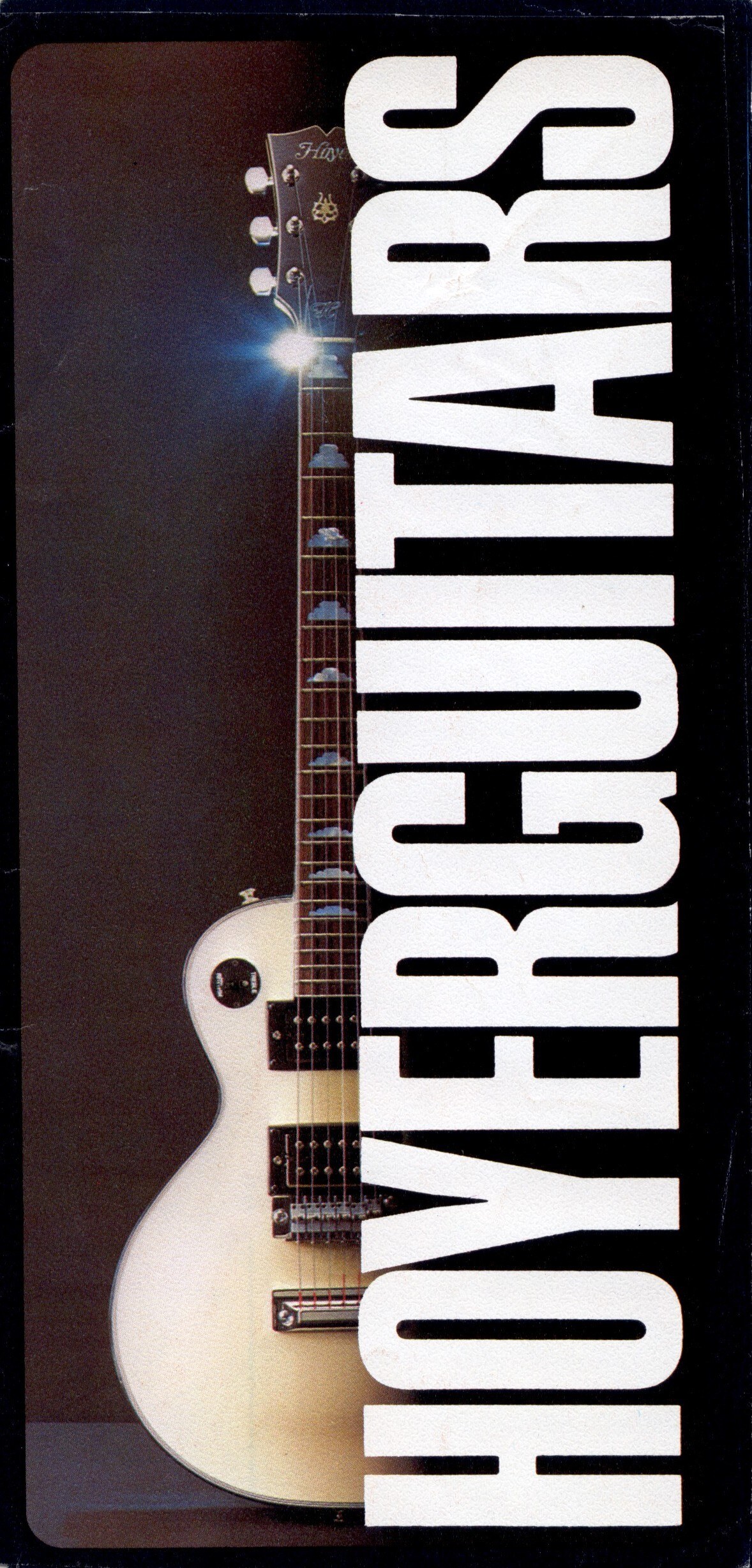
Timeline
- 1631 The first violin maker in the region is recorded in Graslitz (Kraslice).
- 1669 The first violin makers’ guild is founded in Graslitz.
- 1677 The Markneukirchen guild is founded.
- 1723 The first violin maker in Schönbach (Luby u Chebu) is recorded.
- 1838 Violin maker Johann Josef Hoyer (1815–1876) founds his musical instrument and string business in Schönbach.
- 1867 Franz Hoyer (1842–1878) takes over his father’s business.
- 1874 Franz Hoyer adds guitars to the range.
- 1878 The widow Elisabeth Hoyer (1842–1920) runs the business.
- 1890 Siblings Rosalia (b. 1867) and Josef Hoyer (1870–1956) continue the firm.
- 1894 Josef Hoyer founds a workshop for plucked instruments.
- 1896 Gold medal for Josef Hoyer in Hohenelbe (Vrchlabí)
- 1897 Silver medal for Josef Hoyer in Bodenbach (Podmokly)
- 1913 Gold medal for Josef Hoyer in Komotau (Chomutov)
- 1919 Arnold Hoyer (1905–1967) begins an apprenticeship with his father Josef Hoyer
- 1936 Arnold Hoyer opens a workshop and shop in Cologne; brother Rudolf Hoyer runs the Schönbach works.
- 1942 Arnold Hoyer returns with his family to Schönbach
- 1945 Arnold Hoyer and family leave Czechoslovakia
- 1945 Relocation to Bavaria and production begins in Tennenlohe under Arnold Hoyer
- 1948 First post-war catalogue: models “Solist” (No. 20), “Herr im Frack” (No. 16), “Meisterklasse” (No. 15) and an electric Hawaiian guitar (No. 22) among others.
- 1949 Founding of the violin makers’ settlement in Bubenreuth
- 1953 The Hoyer-Spezial (No. 24) enters the range, as does a “fully electric guitar” with pickup and built-in amplifier (No. 25)
- 1957 Registration of the “Arnold patent bridge”
- 1958 Introduction of the “Bianka” (No. 44)
- 1960 Introduction of the tubular guitar “Fantastik” (No. 55)
- 1961 First solid-body guitars
- 1967 Walter Hoyer (1938–2026) takes over management of the firm.
- 1977 Introduction of the Foldaxe
- 1977 Start of the HG series
- 1979 Eagle guitar and bass
- 1985 Numerous new models including Dreamer and Stax
- 1987 Production ceases
- 2009 Martin Ritter, Singapore, acquires the trademark rights
- 2026 Re-launch of Hoyer Guitars